
How to Size a Water Booster Station
A practical walk-through of flow, head, redundancy, and control decisions for municipal and rural water systems.
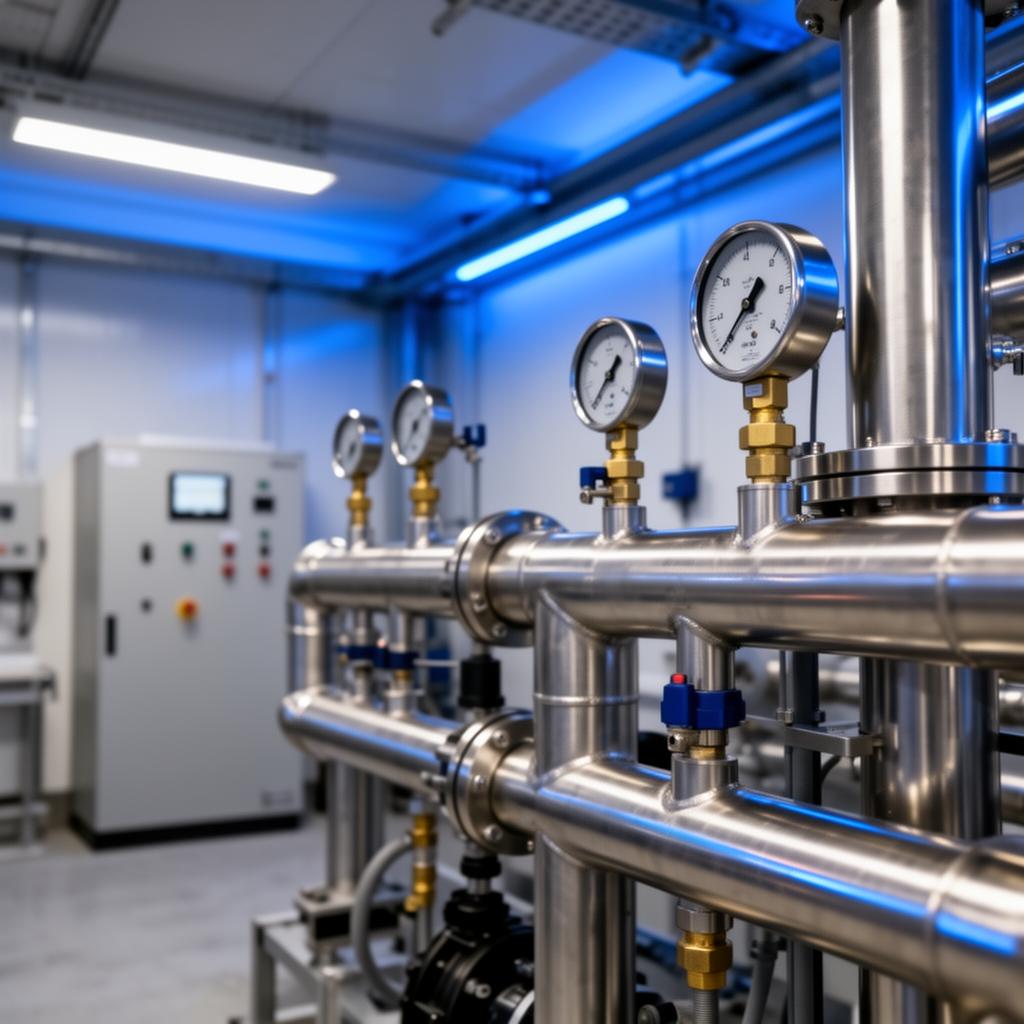
Sizing a water booster station is one of those engineering exercises that looks simple on paper and gets complicated the moment a real distribution system is involved. At its core, the job comes down to two numbers: the peak design flow the station has to deliver and the total dynamic head it has to overcome at that flow. Everything else, including pump count, motor horsepower, piping diameter, control strategy, building footprint, and electrical service, follows from those two figures. Get them right and the station will quietly do its job for decades. Get them wrong and you end up with cavitation, short cycling, blown seals, energy bills that nobody can explain, and a phone that rings at 2 a.m.
At Dakota Pump we have built packaged booster stations for everything from a 35-home rural water co-op to large municipal pressure zones serving tens of thousands of residents. The process we walk through with engineers and operators is the same in either case, just scaled to the project. This article is the long form version of that conversation: how we approach flow, head, redundancy, controls, and the field details that determine whether a station performs as designed once it is installed.
Start with a credible demand curve. Average day demand is a useful planning number, but a booster station does not get sized for the average day. It gets sized for the worst few hours of the worst day of the year, plus whatever fire flow the local authority requires while that demand is happening. We typically ask for at least three years of SCADA data from the upstream master meter or finished water reservoir, then look at maximum hour, maximum day, and the ratio between them. In small systems that ratio can easily reach 3.5 or 4. In larger, more diversified systems it tends to settle closer to 2.0. The point is to measure it rather than assume it, because the difference between a 350 gpm station and a 700 gpm station is rarely worth guessing about.
Layer in growth. A booster station is a 30 to 50 year asset and the surrounding service area is almost never static. We ask for the comprehensive plan, the most recent water master plan, any pending annexations, and any large industrial or agricultural users that may connect during the design horizon. It is far cheaper to oversize a building, a manifold, and an electrical service on day one than to retrofit them in year twelve. That does not mean throwing the largest pumps possible at the problem; it means designing the station so a third or fourth pump can be added in the future without rebuilding what is already there.
Then add fire flow. The required fire flow at the served pressure zone, for the required duration, must be available simultaneously with maximum day demand unless the local code explicitly allows otherwise. In most jurisdictions that means the station has to deliver max day plus fire flow with the largest pump out of service. This is the single most common reason a booster station ends up larger than the owner initially expected, and it is also the most common reason a poorly designed station fails its acceptance test.
With a design flow in hand, the next job is to calculate total dynamic head. TDH is the sum of static lift from the suction source to the highest service point, the desired residual pressure at that point, and the friction losses through the suction piping, the station manifold, the discharge piping, and the distribution system between the station and the controlling node. We build a hydraulic model whenever the system is large enough to justify one, and we hand-calculate the rest. A common mistake is to use the discharge pressure setpoint as if it were TDH; the setpoint is a control target, not a hydraulic requirement, and the two only match at one specific flow. The pump has to satisfy the system curve across the full operating envelope, not just at the nameplate point.
Pay particular attention to the suction side. Booster stations pull from finished water reservoirs, ground storage tanks, master meters, or sometimes directly from a transmission main. Each of those sources has a different available net positive suction head, and each one varies with tank level, upstream demand, and time of day. We calculate NPSH available at the worst expected suction condition, then compare it to NPSH required by the candidate pump at runout, not just at the design point. If the margin is thin, we change the pump selection, lower the pump setting, or upsize the suction header before we ever release the drawing.
Pump count and arrangement come next. Our default for municipal work is N+1 redundancy, meaning the station meets design flow with the largest pump out of service. For critical or sole-source systems we will go to N+2. Three pumps is the most common arrangement on small to mid-size stations because it gives a clean staging pattern, keeps each pump in a reasonable efficiency band, and allows lead-lag-lag alternation that evens out runtime. Four and five pump stations are common above roughly 1,500 gpm, where splitting flow across more, smaller pumps keeps the building height down and keeps each pump operating closer to its best efficiency point.
Match the pump curves to the system, not the other way around. A pump that sits far to the left of its BEP at low flow will short cycle, run hot, and wear bearings quickly. A pump that runs far to the right will cavitate, draw excess current, and shorten seal life. We look for selections where every staged combination, from one pump at minimum speed up to all pumps at full speed, falls inside the manufacturer's preferred operating region. If no single pump model can cover the full envelope, we will mix sizes, typically a smaller jockey pump for low overnight demand and larger duty pumps for daytime and fire flow. Mixed-size stations are slightly more complicated to control, but they save significant energy over their service life.
Variable frequency drives are the other major sizing decision. A properly applied VFD lets one pump cover a wide flow band efficiently, holds discharge pressure within a few PSI through massive demand swings, and eliminates the water hammer that plagues across-the-line starters. The affinity laws are not subtle: cutting pump speed twenty percent cuts shaft power roughly in half. In any system with meaningful demand variability, the payback on VFDs is usually measured in single-digit years, often faster when utility rebates are available.
That said, VFDs are not free and they are not magic. They add heat to the control room, they require harmonic mitigation on weak services, and they need a real tuning effort during commissioning. A station that ships with factory-default PID gains will hunt, overshoot, and frustrate the operator until somebody sits down with a laptop and tunes it to the actual system. Our controls team handles that tuning on every Dakota Pump station before we leave site, and we document the final parameters so the next technician inherits a known good baseline.
Control strategy ties the hardware together. The two questions that matter are what variable the station is controlling to and how it transitions between pumps. Constant discharge pressure is the default for most distribution systems, with the setpoint chosen to maintain target pressure at the controlling node during peak demand. Flow-paced control is appropriate where the station is filling a downstream tank rather than serving pressure directly. Remote setpoint, driven by a pressure transducer at the far end of the system, is the most efficient option when the communication path is reliable, because it lets the station lower its discharge pressure whenever the distribution system can tolerate it.
Pump staging should be smooth, hysteretic, and biased toward fewer transitions. We typically stage the next pump on at a sustained speed threshold, hold it through a short timer, and stage off at a lower threshold so the station does not chatter between one and two pumps during a borderline demand. Lead-lag alternation by runtime keeps wear even. Soft handoff during staging, where the new pump ramps up while the existing pump rides through, eliminates pressure dips that show up as customer complaints.
Manifold, valving, and piping inside the station deserve as much attention as the pumps themselves. Suction and discharge headers should be sized for velocities under five feet per second at design flow, with eccentric reducers on the suction side to avoid trapping air. Each pump gets an isolation valve on suction and discharge, a check valve sized for the actual flow rather than the line size, and a removable spool so the pump can be pulled without cutting pipe. Pressure transducers go on a stilling well off the discharge header, not directly in the flow stream where turbulence will give the PID loop something to chase that is not really there.
Surge analysis is non-negotiable on any station with significant static head or long discharge piping. A pump trip on a long force main can generate pressures well above the pipe rating, and a station that controls the surge poorly will eventually break something expensive. Soft-start VFDs handle most cases. Where they do not, we add surge anticipator valves, air-vacuum valves at high points, and sometimes a small surge tank. The analysis takes a day; the broken main takes a season.
Electrical service and standby power are the last big sizing decisions. The service size has to cover all pumps at full load, plus the building loads, plus the inrush of the largest motor starting across the line if a VFD ever fails to a bypass. Standby generation is a project-by-project conversation. For critical systems we install on-site generators sized to run the station at firm capacity with automatic transfer. For less critical systems we provide a manual transfer switch and a generator receptacle so a portable unit can be connected within an hour. Either way the decision should be made early, because it drives the building footprint, the fuel storage requirement, and the permitting timeline.
Once the station is sized, the work shifts to packaging, factory testing, and field commissioning. Dakota Pump builds, wires, and pressure-tests every station in our South Dakota facility before it ships, which moves the messy work off the job site and into a controlled environment. We run each station against a simulated system curve, verify pump performance at multiple points, exercise every alarm, and document the results. The package arrives at the site as a single skid or a pre-assembled fiberglass enclosure, sets on its pad in a day, and is ready for utility connections.
Commissioning is where good engineering becomes a working station. We start with mechanical checks: rotation, alignment, lubrication, valve positions. We move to controls: I/O verification, alarm testing, communication with the customer's SCADA. We finish with hydraulic performance: pump curves verified against actual conditions, PID loops tuned to the real system, staging thresholds set based on observed behavior rather than catalog defaults. The customer gets a binder, the operators get hands-on training, and the station goes into service with documentation that will still be useful a decade from now.
If you are scoping a new booster station, the most valuable thing you can do before talking to any vendor is to assemble three pieces of information: a credible demand curve with both maximum hour and maximum day, the controlling pressure node and its required residual, and the suction condition over the full operating range. With those three inputs we can return a pre-engineered package recommendation, a budgetary number, and a one-line drawing within a few business days. Send the project our way and we will treat it like our own system, because the operators who inherit it are the ones we want to keep happy for the next thirty years.