Where VFDs Actually Save Energy in Water Systems
Variable speed is not magic. In the right application it pays for itself in months. In the wrong one it adds complexity for nothing.
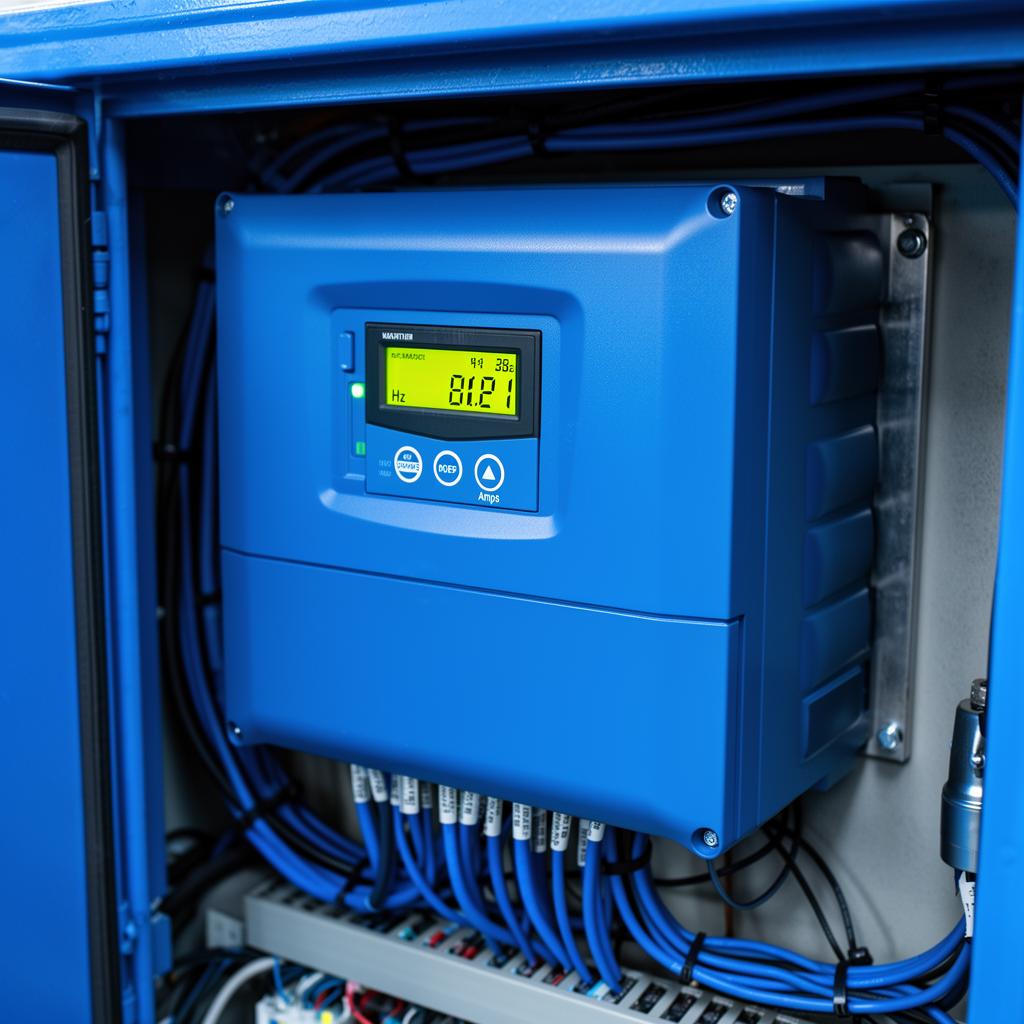
Variable frequency drives are one of the most oversold and one of the most underused technologies in water and wastewater. Oversold because vendors have spent two decades promising fifty percent energy savings on every project regardless of duty. Underused because operators who got burned by the oversell have become reflexively skeptical and now leave drives out of applications where they would pay back in single-digit months. The truth, as usual, sits between the two extremes and depends almost entirely on the duty cycle of the specific system. This article lays out where VFDs genuinely save energy in water systems, where they do not, and how to think about the decision on any project.
The physics is unambiguous. The affinity laws govern centrifugal pump performance and they are not subtle. Flow scales linearly with speed. Head scales with the square of speed. Power scales with the cube of speed. The practical implication is that a centrifugal pump running at eighty percent speed delivers eighty percent of design flow, sixty-four percent of design head, and consumes about fifty-one percent of design power. The savings are real and they are large, but they only show up when the pump actually runs at less than full speed for a meaningful fraction of its operating time. A pump that always runs at full speed gets no benefit from a drive and pays an efficiency penalty of two to four percent for the drive itself.
Booster stations are the strongest VFD application in water. The demand on a booster station varies continuously through the day, through the week, and through the year. A station sized for peak summer afternoon demand spends most of its hours, especially overnight and during cooler months, at flows well below design. Across-the-line pumps handle that variability by cycling on and off against a pressure tank or by throttling against a control valve, both of which waste energy. A VFD-equipped booster station ramps pump speed continuously to hold the pressure setpoint, runs one or two pumps where three would otherwise cycle, and converts the demand variability directly into electrical savings.
The economics on a typical booster station are favorable enough that we recommend VFDs as the default rather than the option. A municipal booster station serving a few thousand connections will commonly see twenty to forty percent reductions in annual energy use compared to an across-the-line configuration with the same pumps, plus meaningful reductions in pump cycling that extend bearing and seal life. Utility rebate programs in many states cover a significant fraction of the incremental cost of the drives, which shortens the payback further. We have seen payback periods of less than three years on retrofit projects and less than two years on greenfield installations.
The control benefits are nearly as important as the energy benefits. A VFD-controlled booster station holds discharge pressure within a few PSI through massive demand swings. The customer complaints about pressure fluctuations during morning peak demand simply stop. Water hammer events during pump starts and stops are eliminated, which extends the life of every pipe, valve, and meter downstream of the station. Pump staging becomes smooth rather than abrupt, which removes the most common nuisance alarm category on the SCADA system. Operators stop fighting the station and start ignoring it, which is the highest compliment a station can earn.
Wastewater lift stations are a more nuanced application. A traditional lift station fills and empties its wet well in cycles, with each cycle pulling the level from a high setpoint down to a low setpoint at full pump speed. That arrangement is energy efficient when the inflow is intermittent and the duty cycle is low, because the pump runs at its best efficiency point during each cycle and sits idle the rest of the time. Adding a VFD to a station like that adds complexity and cost without adding meaningful savings, because the pump is already operating efficiently when it runs.
VFDs make sense on lift stations with continuous or near-continuous inflow, where the alternative to variable speed is constant cycling at high frequency. A station that handles steady industrial discharge, treatment plant return flow, or large diurnal sewershed inflow can run one pump at a modulated speed continuously instead of cycling two pumps every few minutes. The savings come from reduced cycling losses, reduced wear, and the ability to match pump output precisely to inflow rather than overshooting on every cycle. The control benefits also matter: a smoothly modulated discharge into a downstream treatment plant is much easier on the plant than a series of slugs.
VFDs also make sense on any lift station with a long force main, regardless of duty cycle. The soft-start capability eliminates the surge events that punish long force mains during pump starts, and the soft-stop capability eliminates the column separation events that punish them during pump stops. The energy savings on a low-cycle station may be modest, but the avoided main breaks and avoided air-vacuum valve failures pay for the drives by themselves over the life of the system.
Irrigation systems are a strong VFD application that often gets overlooked. Agricultural and golf course irrigation systems typically have widely varying flow demands as different zones cycle on and off through a watering schedule. A constant-speed pump in that service either runs against a control valve, wasting energy as heat, or cycles on and off against a hydropneumatic tank, wasting energy in start transients and wearing components. A VFD-driven pump matches output to demand zone by zone, holds discharge pressure within tight tolerances, and dramatically reduces energy use compared to either alternative. The payback in commercial irrigation is often under two years, especially in regions with high electricity costs or with utility rebates.
The same logic applies to any system with throttled discharge as the primary flow control mechanism. Process loops in industrial water service, transfer pumps moving water between tanks at varying rates, and any application where a control valve sits mostly closed during normal operation are all candidates for VFD retrofit. The energy that is currently being dissipated across the control valve is the energy that a VFD would save. A site walk with a clamp-on ammeter and a few hours of flow data is usually enough to estimate the savings within a useful margin.
Where VFDs do not pay back. Constant-duty applications where the pump always runs at full speed gain nothing from variable speed and lose the drive efficiency. Small horsepower applications, generally under about five horsepower, often do not generate enough annual energy use for any percentage savings to justify the capital cost. Applications with very low duty cycles, where the pump runs only a few hours per week, similarly do not generate enough run time for the savings to add up. And applications where the upstream electrical service is weak enough that the harmonic content of the drive output causes problems can require harmonic mitigation that erases the savings.
Each of these is a real situation that we encounter, and each one is the reason the right answer to whether to use a drive is always project-specific. A blanket policy of always use VFDs is wrong. A blanket policy of never use VFDs is also wrong. The right policy is to do the duty cycle analysis, calculate the projected savings against the projected capital and harmonic mitigation cost, and let the math decide.
Application details that affect the payback. Cable lengths between the drive and the motor longer than about a hundred feet require either inverter-duty motors with appropriate insulation systems or output filters between the drive and the motor. Either solution works; both add cost. Motors retrofitted from across-the-line service to VFD service should be confirmed as inverter-duty rated or replaced. Submersible pump motors in older lift stations may not be rated for VFD service and may fail prematurely if a drive is added without verifying the rating.
Harmonic distortion on the upstream electrical service is the other detail that requires direct attention. Drives generate harmonic current on their input side, which distorts the voltage waveform on weak services and can cause problems for other equipment on the same service. Most modern drives include passive harmonic filtering, and active harmonic filters or eighteen-pulse rectifier configurations are available for projects that need lower distortion. The required level of mitigation depends on the size of the drive relative to the service capacity, on the utility's tariff requirements, and on whether sensitive equipment shares the service. A short conversation with the serving utility during design avoids problems during commissioning.
Tuning is not optional. A VFD-equipped pump station that ships with factory default PID gains will hunt, overshoot, oscillate, and frustrate the operator until somebody sits down with the system and tunes the loop to the actual system response. Tuning is a few hours of effort during commissioning that pays back across the life of the station in reduced wear, fewer alarms, and tighter setpoint control. Dakota Pump's controls team tunes every station before we leave site and documents the final parameters so the next technician inherits a known good baseline. Stations tuned that way stay tuned. Stations that depend on the operator to figure out the parameters from the manual generally do not.
Retrofit versus new construction is a useful distinction for budgeting. On a new station the incremental cost of VFDs over across-the-line starters is modest because the panel is being built either way, the only question is which components go inside. On a retrofit project the cost includes a new control panel, new conduits and conductors, potentially harmonic mitigation, and the labor to integrate the new controls with the existing station. The retrofit cost is larger, but the energy baseline against which the savings are measured is also typically larger because the existing station is rarely well-optimized. Retrofits of older booster stations, in particular, often produce dramatic savings because the original design constrained pump selection to whatever was available across-the-line.
Utility rebates can change the project economics significantly and are frequently underused. Most investor-owned utilities and many municipal utilities offer prescriptive or custom rebates for VFD installations in water service. The rebate paperwork is straightforward; the dollar amounts can cover ten to thirty percent of the project cost in many cases. Dakota Pump's project team helps customers navigate the rebate process on every project where one is available, and we can usually quote both the gross project cost and the net cost after rebates as part of the proposal.
Two final pieces of advice. First, measure before and after. The most valuable thing a utility can do on a VFD project is to baseline the energy use of the existing station for at least a month before the retrofit, then measure again for at least a month after. The result is a documented savings number that justifies the next project, supports the utility's reporting obligations, and silences the inevitable internal skeptics. Stations that get measured both ways consistently meet or exceed the projected savings. Stations that get retrofit without measurement generate no usable data and no organizational learning.
Second, do not let perfect be the enemy of good. A VFD project that captures eighty percent of the available savings, ships on schedule, and runs reliably for twenty years is dramatically more valuable than a project that aimed for ninety-five percent savings, added three months of engineering review, and produced a system the operators do not trust. The Dakota Pump team is happy to walk an existing station, audit the duty cycle, and recommend whether a VFD retrofit is worth pursuing. If it is, we will quote the project and stand behind the savings projection. If it is not, we will say so and recommend where to spend the same budget for a better return. Either way the goal is the same: stations that use less energy, last longer, and require less attention.